
Creighton University Athletics
Bluejay Women's Tennis Has Real Family Tapestry
2/3/2026 6:15:00 PM | Women's Tennis
Sewn into the nearly 50-year history of Creighton Women's Tennis are lasting impacts of players like Katie Chiu (2003-2007), Jennie Hartjes (2011-2015) and Malvika Shukla (2020-2024) as well as Big East Tournament finals appearances, All-Big East honors and ITA All-Academic Team recognitions. More than those accomplishments, the history and legacy of this storied program is woven in the details: team dinners, road trips and relationships that last a lifetime.
For the Creighton women's tennis program, legacy is not just the lasting mark an individual player leaves on the program — it's the lasting legacy the program leaves on the player.
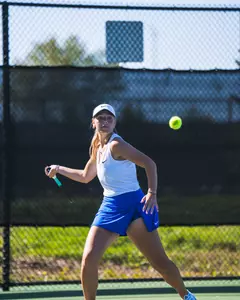
Omaha native and junior women's tennis player Elsa Jurrens is stitched into the fabric of Creighton tennis. At every match, she stands on the side of the court, lifting her teammates up between points with the same urgency she brings to her own matches.
Her connection to Creighton tennis emerged long before her own career. Elsa is not the first member of her family to represent the white and blue. Her mother, Traci Jurrens, formerly Traci Miller, represented the Bluejay program from 1993 to 1997.
And just like her daughter, 20-plus years later, Traci played under women's tennis head coach Tom Lilly. Traci was even teammates with Lilly's wife, Jean. Their story, however, began taking shape even before Traci stepped on campus.
I was an assistant tennis pro at a country club and Traci must have been about 12 at the time, recalled Lilly. She was … one of the top juniors in the region, and she wanted good players to hit with, good people to hit with, so the head pro who would hire me to go and hit balls with her. That was the first time that I met Traci.
That early connection resurfaced years later when Traci visited Creighton as a senior in high school and was introduced to the women's tennis team as a prospective recruit. At that time, Lilly was working as an assistant coach for the Bluejay tennis program. Until that visit, Traci — a Nebraska native — always pictured her college years unfolding at the University of Nebraska. Creighton wasn't even on her list until she toured the school on her recruiting visit.
Yet after meeting the coaches, staff and her soon-to-be teammates, any visions of red and white disappeared, replaced firmly with dreams of what her college experience could be like in the white and blue.
I fell in love [with Creighton] immediately. I knew it was the right place for me [because of] the size, the values of Creighton [and] the Jesuit education in the tennis team, reminisced Traci. It went from [being] a university I didn't think I was going to go to … [to] the perfect fit for me.
That feeling of belonging, sparked from Traci's first steps on campus, never lessened over her four years. Neither did the close connection between her path and Lilly's.
In February 1997 — Traci's last semester at Creighton — Lilly was named head coach. Taking over midseason wasn't easy, but he said having strong players like Traci helped ground the program as he found his footing.
From Traci's perspective, the traits Lilly saw in her were mirrored in him. His calm demeanor and encouragement-based coaching style helped maintain continuity through the coaching transition.
That encouragement showed up in the everyday moments that followed Lilly's promotion, too, including one practice that stood out to both player and coach for different reasons.
Traci had a bad practice, and she was our best player, remembered Lilly. She knew that the next day she was playing Wichita State's number one [player], who was one of the best, if not the best, player in the region.
It was probably my biggest match of the year the next day, and I did not play well at practice. Nothing felt right. I just seemed off, recalled Traci of that same moment.
Sitting her down, Lilly's advice was simple.
We talked, and I said, 'You know what? You had a bad day today. Let's just call it what it is. It doesn't mean you're going to show up tomorrow and have a bad day, he said. The next day, Traci played unbelievable.
I had the biggest win of my career the next day, remembered Traci fondly.
Looking back, Lilly remembers that moment as a representation of Traci's resilience, a reminder to stay present and put the bad moments behind you. Traci remembers that moment as the epitome of Lilly's impact on players.
A coach knows when you need encouragement, knows when you need pushing, and my experience was he [Lilly] was very good at knowing what you needed at the time. He knew at that moment what I needed, said Traci.
Decades later, Lilly still tells that story, returning to it on days when his team needs a reminder of the power of persistence in the sport and in life. It is a small lesson that continues to shape players long after Traci graduated.
One of those players is Traci's own daughter, Elsa. Now, it is her turn to build her own legacy at Creighton.
Three years ago, in 2023, Elsa stepped onto the same courts her mom had played on 20 years prior, the same ones Elsa has played on since she was five years old, and the same ones that witnessed the quiet legacy of Traci and the then-new head coach Lilly begin to unfold.
It's really cool that my mom brought me into tennis, and now she gets to watch me play on the courts that she grew up on. Just having that support and her coaching, I will forever be grateful for it, said Elsa.
For Elsa, committing to Creighton in 2022 seemed natural. She had, after all, known the Lilly family since she was little.
I think definitely knowing the coaches and [my mom] having such a high opinion of Tom … helped me come to Creighton because you gamble on coaches when you don't know, and knowing him and Jean since I've been a kid really helped, said Elsa.
Elsa's commitment also carried meaning for Lilly, connecting decades of Creighton tennis history in a single moment.
It means that I'm really old, chuckled Lilly, thinking about the full circle moment of Elsa picking Creighton. Jean and I joked that we were going to be tennis grandparents, even though it's only one semester that I was head coach for Traci.
Though committing to Creighton was easy, Elsa's journey to playing as a Bluejay wasn't without its challenges.
In the spring of her senior year of high school, Elsa tore her ACL, meniscus and other ligaments. From that moment through her freshman year at Creighton, Elsa was forced to watch from the sidelines.
I spent most of my freshman year rehabbing that injury and getting back. It was a long process — a 10-month process — but Creighton was really awesome about it, recalled Elsa.
The 2023-2024 season was difficult for Elsa, as she was limited to just 15 minutes of practice a day and couldn't play any matches as she recovered. But through the hardship, she found that her presence and support for her team mattered just as much as any point she could win on the court.
[I was just] trying to support my teammates in any way I could, noted Elsa. I think I was able to see firsthand how much cheering and encouragement, while your teammates are playing, [is] important.
While Elsa's playing time was limited by injury her first year, that circumstance was instrumental in shaping her role on the team since then, allowing her leadership and support to grow in meaningful ways.
[She's really] been growing into that role, explained Lilly. Really, she's a competitor. She wants to play as much as she can, and she's done well when she's gotten into matches at times, but the main thing when you're in that situation is you have to have a good attitude. … [She's just] a team player [and] she puts the team first.
Though not the loudest on the team, Elsa has a quiet presence — much like her mom's — that draws attention when it matters, especially as she has grown into her role on the team. It is a trait that Lilly has long admired and seen before.
Traci was quiet and Elsa's quiet … [but] those are two people that when they are speaking, everybody should be listening because they probably only talk when it's important, he said.
Now, quiet leadership helps guide Elsa's own path at Creighton. Maybe that's what makes her coaches' focus on listening so meaningful to her.
I think Tom and Jean are great coaches in the aspect that they really listen to their players, I think more than other Division I coaches would. We're a very close team, and that's what makes us special and different from other teams, said Elsa.
That close-knit culture of support is part of a legacy that stretches back to Traci's time at Creighton.
The Bluejay women's tennis program may have changed since Traci left her mark on the court, but the lessons it taught her and the legacy it leaves continue to endure. In this, Traci finds nostalgia for her own experiences and reassurance for the one Elsa is forging.
Playing a sport and being in college teaches you so much about time management, showing up for the team [and] being a team player, and that carries over into the real world, said Traci. That was what I could see for Elsa [at Creighton] as well. It's not just playing, it's everything that you experience translates into real life.
For Lilly, in his 36th year as a part of the program, having a former player place her trust in him as a coach years later is a remarkable experience, one that brings the story full circle.
To have someone who's now sending their daughter here to play for us, and she played for us, that's a very positive sign that we have built that culture up, said Lilly. If I was going to send my daughter somewhere, I would really want to know that the culture is very strong and positive.
Now, on any given afternoon at Hanscom Tennis Center, Elsa looks like just another Bluejay women's tennis player — stretching, cheering on her teammates, grinding through another practice.
But woven into those ordinary moments is something far less common: a lasting imprint passed quietly from mother to daughter and a program with a legacy that grows stronger, becoming more meaningful to everyone it touches with every passing year.